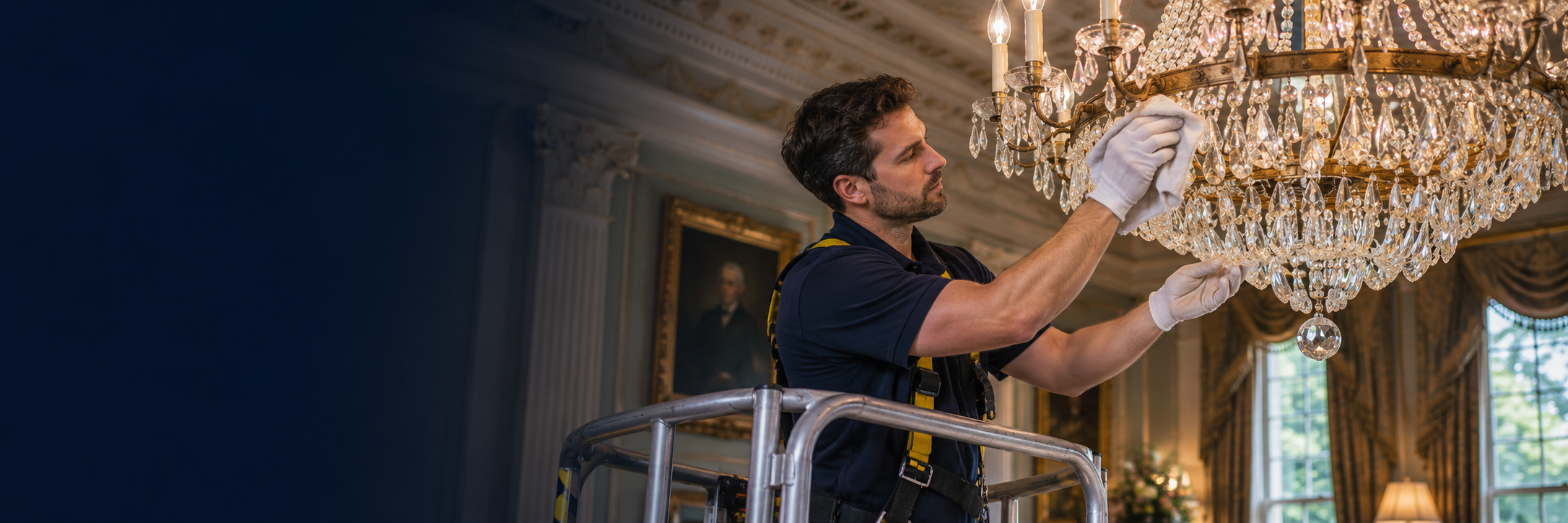
Discuss safe access and a cleaning method that suits the materials and condition of each fitting.
Nova Clean Leeds · West Yorkshire
Chandelier cleaning in Leeds with a method suited to the fitting, its finish and the room below
A chandelier can lose much of its definition while the room around it still looks immaculate. A thin layer of dust on glass drops softens their edges, fingerprints catch the light after a bulb change, and a dark coating that looks like dirt may turn out to be the original finish on a metal arm. The useful first question is what each part of the fitting is made of and how the chandelier is installed. Nova Clean Leeds discusses cleaning for decorative pendants and chandeliers in homes, hotels, restaurants and managed buildings, with the scope agreed around the fitting and the available access.
For an initial assessment, send a photograph of the entire fitting taken from the floor and a wider view that shows where it hangs. Tell us whether it is over a landing, a dining table or an open reception, the approximate height and any maintenance records you have. Nobody needs to climb to take those photographs. If a bulb holder is loose, part of the fitting looks unstable or water has recently entered the ceiling, tell the person responsible for the property. The condition needs attention before a visit to clean the decoration can be arranged.
Identify which parts are glass, crystal, acrylic, metal or a coated finish
Two fittings of similar shape can respond very differently to the same treatment. A cut glass drop may be mounted on a thin pin, while an acrylic piece can have an identical silhouette and be more susceptible to scratching or damage from an unsuitable product. Painted or plated arms may carry a finish that softens, dulls or marks if treated aggressively. Even a contemporary pendant can combine glass, felt, painted steel and delicate wiring within a small space. Labels, installer records or care instructions can be useful when the materials cannot be identified from the floor.
Some metal surfaces retain a deliberate patina, and the colour may vary depending on where the fitting receives light or where previous polishing took place. Discuss whether the finish is meant to look bright and even before asking for a deep polish. For a period chandelier in a house in Roundhay or a decorative pendant at a Leeds city centre hotel, an unobtrusive test can help establish how a suitable surface responds. Any uncertainty about a fragile or valuable finish should be settled with the owner before the visible sections are treated.
Plan access by looking at the room as well as the ceiling height
A fitting over the centre of an empty hall is a different proposition from one suspended over a curved staircase. Accurate measurements of the room, access doors and overhead clearance help establish which equipment can reach the job. Mention floor slopes, fixed furniture, narrow passages or a landing that cannot accept equipment. If the chandelier is above a stairwell, photograph the floor at the top and bottom from safe positions. Where the fitting hangs over a table or cabinet, explain whether the furniture is movable and who is able to move or protect it.
In a hotel or restaurant, there may be pedestrians moving beneath the fitting at almost every hour. Agree an access window and a person who can close the affected area. A restaurant might release a dining room between services, while a reception chandelier is more practicably addressed before visitors arrive. For an apartment building, tell us whether facilities staff control the lift and whether access needs to be agreed with neighbouring occupiers. Any work at height needs a suitable plan for the space, including the floor conditions and keeping people clear of the area below.
Agree how electrical safety will be managed before cleaning begins
Decorative cleaning and electrical maintenance are separate responsibilities on the job. A competent person must address any electrical isolation needed for the work and ensure the fitting cannot be re-energised inadvertently. Inform the building manager of the intended timing, especially where lighting supplies more than one room or when safe access relies on other lighting being available. A switched-off wall control on its own is insufficient for work that requires electrical isolation. Let the person responsible for the electrical installation coordinate this part of the visit and identify any building procedures that apply.
Surface cleaning is limited by the condition of the fitting and what can be reached without interfering with electrical parts. A loose holder, a damaged cover, an exposed conductor or a possible leak is a reason to pause and ask the responsible person to arrange a competent inspection. Replacing sockets, changing wiring and making an installation safe fall outside a decorative clean. If the owner would also like bulbs changed or a pendant lowered, raise that in advance. The building may have a service system for doing this and should identify who can operate or maintain it.
Choose an in-place clean or specialist handling of removable components
An in-place clean can be suitable where exposed surfaces are stable, within approved reach and accessible from several angles. It may address dust on the frame, arms and glass or crystal drops that can be handled safely. Pads and tools need to suit the material, and each area should be examined before treatment so that vulnerable finishes are identified. Decoration near electrical parts needs particular care around moisture. If the chandelier has complex layers, agree which parts are in scope and whether the visible results justify more involved access to the inner sections.
A fitting with removable drops or shades may be able to undergo more detailed cleaning, if its design and condition allow it. Older pins can be brittle, some sets include different sizes of drops that look alike at first glance, and a previous repair can make an apparently identical fixing behave differently. Discuss what may be removed, how the positions will be recorded and where items can be placed safely. Where a valuable, fragile or unusually complex fitting needs dismantling, ask the owner or facilities manager to identify the right specialist. The quotation should reflect the actual method agreed after these details are understood.
Address kitchen films, renovation dust and marks according to the deposit
The deposit on a chandelier in an occasionally used drawing room is often mostly loose dust. A fitting near a restaurant service station can collect a film that holds dust in place, while a chandelier near a freshly refurbished corridor may carry fine particles introduced by work elsewhere in the building. Tell us if candles have routinely been lit nearby, if cooking vapours are an issue or if decorators have been working in the room. Mixed layers can change the time needed and may require a material check before any product is chosen.
Certain marks only become visible when the shades or drops are illuminated from behind. Water spotting, fine scratches and clouding can look alike in a hurried inspection. A record of the condition with the lights off or under separate safe lighting can help identify the source of a change. If a product has already been used, pass on its name and describe any effects you noticed. Tell us if renovation work is still generating dust so we can discuss the timing relative to after builders cleaning, particularly if the chandelier hangs above a shared route that trades still use.
Protect the space under the chandelier before the visit
Move fragile belongings, table settings and smaller ornaments out of the affected area in advance where it is safe to do so. A rug, wood floor, stone reception desk or fitted furniture below a fitting may need suitable protection, both from equipment and from material lifted off the chandelier. At a hospitality venue, notify colleagues about any room closure and identify a nearby place to stage equipment without obstructing the entrance or fire routes. During a domestic visit, arrange for pets and other occupants to stay outside the working area.
The layout underneath can make some access methods impractical. A decorative railing may leave little floor space at the top of a stair, or the ground directly below the fitting may be a tiled platform with a change of level. Share information on uneven floors, rugs or thresholds and give notice if a room is scheduled for a furniture change. If there are several chandeliers, number them or identify each one by room. A small pendant in a ground-floor drawing room and a tiered fitting over a stairwell can then be assessed and priced separately.
Compare quotes by checking the agreed components and access programme
The estimate depends on the height and position of the fitting, the quantity and arrangement of drops, the complexity of the frame, the type of deposit and the access equipment required. A tall entrance pendant with a simple shade might take less surface work than a low chandelier with several layers of hanging pieces, even though the access arrangement is more involved. An agreed floor protection method or a restricted working window can also affect the price. Photograph each fitting from different directions if those views are available from the floor.
Ask which visible and accessible elements the proposed price includes, who is responsible for managing any isolation and how excluded areas will be recorded. If decorative components are to be removed and reattached, agree the process at quotation stage. Clarify whether the price includes the access arrangements and whether another visit may be needed after unrelated repair work. For more than one fitting, a schedule by room makes it easier for the property manager to approve the relevant areas and notify staff which spaces will be closed.
Set a finish standard for the actual fitting and review it in the room
For a bright contemporary fitting, the owner's main priority might be a consistent appearance across glass shades with no obvious smears from ordinary viewing positions. In a period house, the focus may instead be on removing loose deposits while retaining the colour and character of the metal. Agree how you will look at the finished fitting, whether from its normal sightline downstairs, from the landing, or under other room lighting. Anything loose, damaged or affected by a worn coating should be described so the owner can decide what to have examined.
Consider a hypothetical reception fitting in a converted building in Holbeck, hung above a stone floor with clear access early in the morning. The first decisions would be who releases the space, how the floor can be protected and whether the building manager needs to coordinate electrical arrangements. The owner can identify the glass elements that matter most from the approach to reception and raise any pre-existing marks on the canopy. A shared record of the agreed scope gives the duty manager a useful basis for reviewing the work before opening the doors.
Send the facts that help Nova Clean Leeds assess the right scope
For a chandelier cleaning enquiry in Leeds, send the postcode, number of fittings, approximate dimensions and height to the lowest part, measured only where this is safely possible. Say whether the fitting is over stairs or fixed furniture, when the room can be closed and what is known about the materials and their condition. Include photographs from the ground, together with any care instructions the owner already holds. If the work is one part of a larger appointment, identify any adjoining rooms or surfaces that should be reviewed so that the different jobs can be scheduled sensibly.
Nova Clean Leeds discusses decorative light fitting cleaning in and around Leeds, including the city centre, Headingley, Chapel Allerton, Horsforth and Roundhay. A visit may be needed where the height, condition or construction is unclear. For a work programme that also involves the main reception, stairs or other rooms, a one-off property clean can be assessed separately. This gives you a clearer picture of the access required for the chandelier and the finish to expect on each part of the property.
Can the clean go ahead while other parts of the premises remain open?
Share the route used by staff and visitors and identify the room or landing that would need to close. Other parts of the premises may remain in use if the responsible person can keep traffic clear of the work area and maintain suitable routes. Ask who is authorised to reopen the space and what the team needs to do before responsibility passes back to venue staff.
Request a quotation from Nova Clean Leeds
Send the postcode, photos taken from a safe position and the details of the work you would like us to assess.
Request a cleaning quote0845 52 805 20