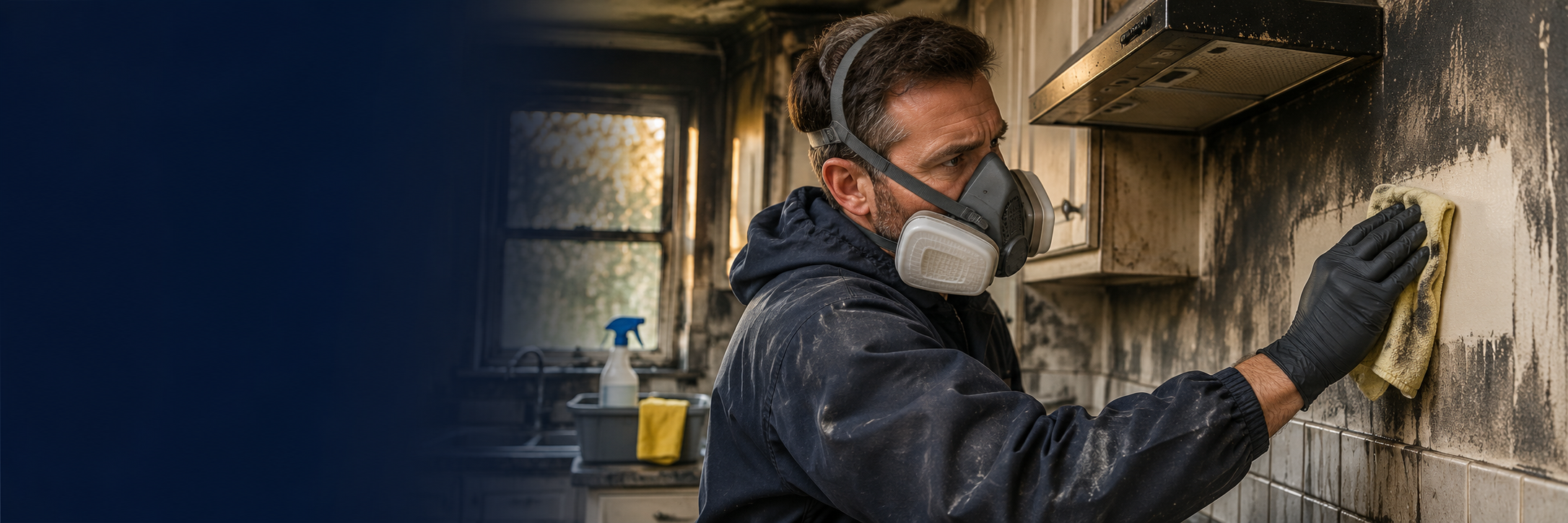
Trace where the smoke settled, protect unaffected belongings and agree what needs attention before decoration begins.
Nova Clean Leeds · West Yorkshire
Fire and smoke damage cleaning in Leeds for rooms affected by soot, smoke and firefighting water
The room where a fire started is often the easiest part of the damage to describe. The more difficult question is what happened on the other side of the door. A hall can look clean in daylight yet show a grey deposit around a frame. Boxes stored upstairs may carry a smell although the room never saw flames. Nova Clean Leeds discusses fire and smoke damage cleaning with householders, landlords and businesses once the premises have been released for access. A useful first conversation identifies the affected rooms, the people authorised to make decisions and the work other trades have already undertaken.
Stay outside any area that has not been cleared for entry. A cleaning booking does not establish that a ceiling, electrical installation or gas appliance is safe. Follow instructions from the fire service and the professionals dealing with the building. If photographs were taken safely after release, keep the originals. You can describe the concern without going inside again. Tell us whether the priority is assessing the extent of smoke travel, recovering a particular possession or preparing a defined area for repair. Those priorities give the initial inspection a practical purpose.
Map the smoke route through the actual building
Begin the room record at the origin identified by the people investigating the incident. Then list connecting doors, corridors, stairs and rooms on the floor above. Note which doors were understood to be open or closed and which information is uncertain. It is quite possible for two rooms the same distance from a fire to show different effects. Their position relative to a doorway, draught or opening can matter more than their distance on a floor plan. A room record helps the assessor decide where to look without assuming that every visible mark was produced by the incident.
In a narrow Leeds terrace the stairwell might link a ground-floor kitchen with bedrooms above. In a converted mill flat in Holbeck there may be a tall open space with beams, high ledges and large glazed areas. One layout puts attention on the landing and door frames, the other raises questions about access equipment and high surfaces. Describe the building as you know it. An assessor can decide where closer inspection is justified. There is no reason for a resident to climb up to a beam or wipe a test mark off a high wall.
Let the residue and finish guide the cleaning trial
Smoke deposits differ in how they sit on a surface. Loose particles can be difficult to remove once smeared. A sticky deposit may cling to a washable finish while an otherwise similar-looking wall absorbs moisture and changes colour. The assessor needs to consider the residue and the material beneath it together. Wiping a patch in the middle of a prominent wall with a wet household cloth can leave a mark that is harder to interpret later. Leave representative surfaces undisturbed until the proposed method has been discussed.
Where a trial is appropriate, agree its location, record the original condition and inspect the result in normal light after it has settled. A white cloth coming away clean is only one observation. Look at the sheen, colour, texture and boundary of the treated patch. A painted wall might lose its soiling but become noticeably more glossy where it has been rubbed. On a long corridor wall, this matters because light from the end window can reveal a change that was invisible under the technician's lamp. The trial should inform the wider scope and any proposed decoration.
Distinguish soot deposits from heat damage and ordinary wear
A blackened surface does not always need the same kind of work as the surface beside it. Loose residue on intact glass, a blistered cupboard door and a worktop discoloured by heat represent different conditions. Cleaning can remove accessible deposits from suitable materials. It cannot restore the original shape of warped plastic or replace the finish lost from scorched timber. A good estimate records those differences before labour is committed to repeated attempts on a permanently damaged surface.
Existing wear also becomes more visible during a recovery job. A worn patch on a banister may have been present long before the fire, while a dark line above the door could relate to the recent incident. If you have ordinary photographs of the property from before, they may help establish the previous appearance. You do not need photographic proof of every defect to ask for advice. Ask the assessor to distinguish an observation from a probable cause, especially where an insurer or landlord may later rely on the written description.
Keep recovered belongings from reintroducing soot
Choose a clean holding area before moving contents. A carefully treated room can pick up residue again when boxes with dusty bases are placed on a clean floor. Agree how the team will identify belongings awaiting assessment, belongings ready for return and items for which the owner must make a decision. Label boxes with the room they came from and a simple account of the contents. That matters particularly where family members are staying away from home and cannot easily search several boxes for a school uniform, pair of spectacles or set of keys.
Discuss individual items with particular value, including musical instruments, photographs, books, textiles and family furniture. Cleaning a varnished wooden frame is different from treating the paper or photograph inside it. A specialist conservator may be appropriate for a delicate object. Electrical equipment also needs its own assessment. Do not switch something on to check whether it survived the incident. Separate the question of whether an item looks clean from whether a qualified professional considers it suitable for use. Record who is responsible for each decision before it leaves the property.
Account for the water used to bring the fire under control
Smoke cleaning and water damage recovery can overlap without being interchangeable. A floor may carry a loose dry deposit near one doorway and have wet coverings nearer the area where water was applied. Tell the assessor whether anyone has extracted water, removed fitted flooring or placed drying equipment. If a ceiling was wet, keep away from it until the building has been assessed. Visible staining on a dry-looking wall does not establish what happened behind the lining or under the skirting board.
The sequence matters when several trades are booked. A team may need to remove approved damaged material before it can reach a hidden wet area. Drying checks may need to finish before a joiner fits new timber. A decorator working too early could cover residue or moisture problems that later show through the finish. Put the cleaning areas and water-affected areas on the same room list, but give each a separate completion entry. That way a room can be recorded as cleaned while everyone understands that another part of its recovery remains open.
Investigate a persistent smoke smell at its source
An odour may be more noticeable after a room has been closed for the night or when heating is used again. Record when and where someone noticed it, without repeatedly returning to test it yourself. Ask the assessor which absorbent items, concealed surfaces or adjacent spaces remain to be checked. The underside of furniture, the backing of a curtain or the top of a cupboard can be easy to overlook when attention is fixed on the visible walls. The presence or absence of a smell is only part of the assessment.
Before agreeing any separate odour treatment, ask what source has been identified and what cleaning or removal is proposed first. Discuss occupancy, access restrictions and the arrangements for a return visit if a concern remains. The family may want to bring bedding or favourite chairs back promptly, but their return makes more sense once both the room and those belongings have been assessed. A heavily scented room gives a poor basis for judging whether an unresolved problem still needs investigation. Agree a convenient way to report concerns after handover.
Arrange work across flats, shops and offices in Leeds
If a kitchen fire in a flat affected a shared corridor, the person instructing the internal work may have no responsibility for the corridor. Give the assessor the managing agent's contact details with permission and explain where the boundary lies. In a city-centre block, the service lift may be used by several trades during the same week. Book access in an order that allows dirty materials to leave before clean items return. Tell the building contact when routes need protection or when residents need advance notice of restricted access.
For a shop in the Leeds arcades or a business unit in Hunslet, stock, displays and customer routes each need a decision. Goods may belong to a concession, a landlord may own fixed equipment and a third party may service ventilation. Ask who can authorise inspection of each part. A soot clean of reachable surfaces does not inspect the interior of an air handling system or certify stock for resale. Keep affected goods clearly identified until the appropriate people have made those decisions. A partial reopening should depend on the condition and use of the area being reopened.
Read the estimate alongside the repair programme
A detailed estimate can separate inspection, test cleaning, treatment of particular rooms, contents handling and the disposal of items approved for removal. It can also record what has been left to the electrician, building surveyor, ventilation contractor or decorator. Ask whether equipment for high-level access is included and how long the building must be available. A small kitchen may take less time to clean than the high open staircase beside it. Pricing by the apparent size of the original fire can therefore miss a substantial part of the work.
If you are arranging an insurance claim, speak to the insurer about its evidence and authorisation requirements before committing to major work or disposal. Keep the estimate, decisions about contents and approved changes in one place. State who can agree extra work when an inaccessible surface becomes visible. If funds or access are limited, agree what can be completed as a defined first phase and what must be assessed afterwards. A staged instruction should leave a clear record so the next person understands the basis on which repair work can proceed.
Prepare a handover a decorator or landlord can actually use
At inspection, stand where a resident or customer would normally see the surface. Look at painted areas from the doorway and from the side under natural light if possible. Check the ledges and frames included in the brief, then refer back to the initial list of limits and existing damage. Record anything that requires redecorating or replacement, including the precise location. A note that a room needs attention is of little use to a decorator who has to decide whether the issue is above a door, behind a radiator or across an entire ceiling.
For a family returning to a home in Moortown, an inventory of items still with a specialist may be just as important as the room inspection. For a landlord in Burley, the priority may be a list of trades still required before the property can be occupied. Arrange who will receive the handover and whether a person not present needs a short written account. Keep keys, entry fobs, appliance instructions and documents separate from items still awaiting clearance so that the next visit can go ahead as planned.
Request fire damage cleaning for a Leeds address
To begin, give Nova Clean Leeds the postcode, the type of property, when access became available and the rooms known to have been affected. Explain if a loss adjuster or property manager is involved, if the building has restricted access or if some belongings require individual decisions. If smoke reached an adjoining business or common area, identify it as a separate concern. You can ask for an initial assessment without estimating what proportion of the building will need treatment.
For premises in Leeds and neighbouring West Yorkshire communities, arrangements depend on the actual building, the state of release, the scope and the availability of the necessary trades. Tell us what happens next in your own timetable, whether that is a joiner's visit, a tenancy inspection or the return of family possessions. It allows the cleaning discussion to concentrate on the information and results needed for that handover, with room for a further decision if something unexpected is found.
Request a cleaning quote or call 0845 52 805 20.