Cleaning services in Leeds - West Yorkshire. Methods, access and the proposed scope assessed for your property.
Solar panel cleaning for domestic and commercial installations in Leeds
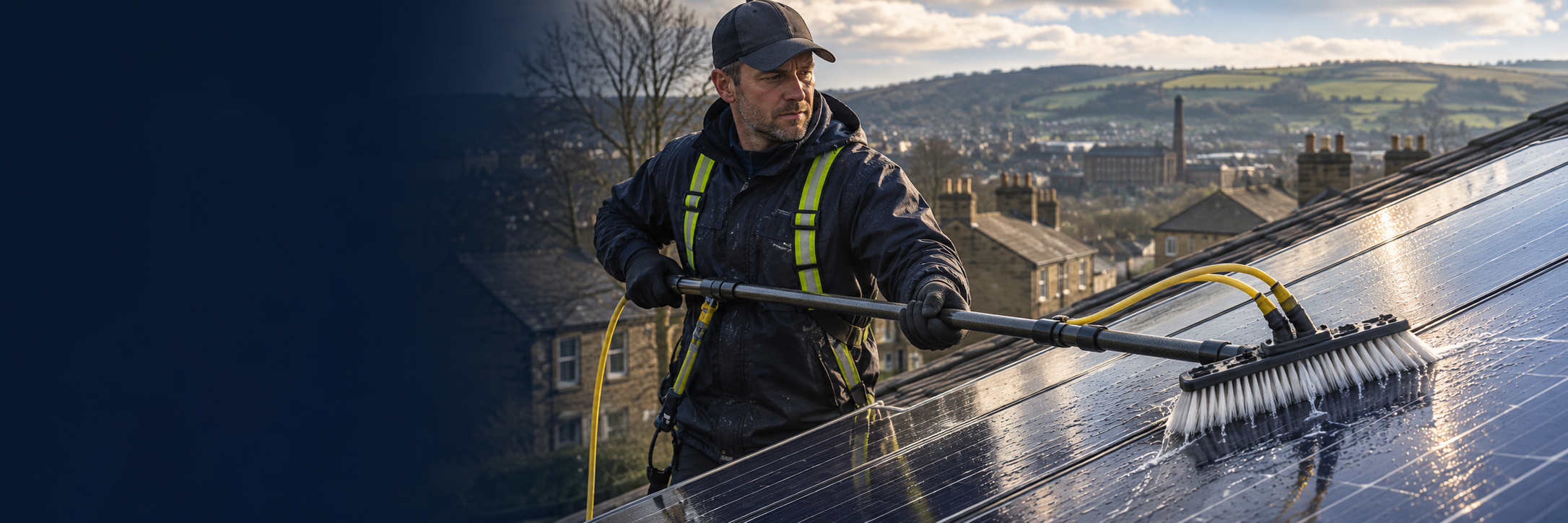
Solar panel cleaning in Leeds should be assessed as work on an electrical installation and a sensitive external surface. A photovoltaic array may collect bird fouling, dust or other deposits, but its appearance alone does not establish a suitable cleaning method or prove that dirt explains a change in output. Nova Clean Leeds discusses cleaning for suitable domestic and commercial solar installations, with the panel condition, manufacturer instructions, access and surrounding risks considered before a scope is proposed. Cleaning and technical maintenance remain distinct responsibilities, particularly where an owner has already noticed a fault or a damaged component.
Start with the postcode, the approximate number of modules and photographs taken safely from the ground. Tell us whether the installation is roof-mounted or ground-mounted, how high it is and which parts can be reached without entering a restricted area. Include any available panel model information and instructions from the installer. Coverage, method and appointment availability are confirmed individually. An enquiry does not require you to inspect wiring, climb onto a roof or attempt to clean a test section before contacting us.
Assess whether cleaning addresses the concern you have identified
Visible deposits can justify a cleaning assessment, especially where fouling or local conditions leave material on the glass. A reduction in recorded generation can also have other causes, including weather, shading or a technical issue. Cleaning should not be presented as a diagnosis of the whole system. If the main concern is an error message, damaged module or unexpected electrical behaviour, the installer or a competent solar maintenance professional may need to assess that issue before cleaning is considered.
Likewise, a fixed cleaning interval is not automatically appropriate for every Leeds array. The roof angle, surroundings, exposure and type of deposit can influence how the surface becomes affected. An installation beside trees differs from one on an open commercial roof. Ask what evidence supports a proposed cleaning schedule and whether a technical maintenance visit would address a separate concern more effectively. The scope should relate to the actual installation rather than an unsupported promise that every array needs the same treatment at the same frequency.
Identify the modules and follow relevant care instructions
Solar modules can differ in their glass, coatings, frames and installation details. Manufacturer instructions and any warranty conditions should inform the proposed cleaning method. Where that information is available, share it with the enquiry rather than assuming that a general window-cleaning process is suitable. A product, brush or pressure that is tolerated by one external surface may be inappropriate for a panel coating or a seal. Uncertainty about the module is a reason to establish the relevant guidance before proceeding.
The assessment should also identify existing damage and vulnerable components. Cracked glass, loose fittings, damaged cable protection or other visible defects require an appropriate technical response. Cleaning does not repair those conditions and should not obscure them. If you have photographs or records from an installer, provide the relevant information without handling electrical parts. The proposed work can then distinguish the cleaning area from anything that needs investigation, repair or authorisation by another competent professional.
Plan access without walking on the panels or relying on fragile roofs
Modules should not be treated as a surface to stand on or as a support for tools. Access needs to protect the installation as well as the people carrying out the work. A roof can include fragile sheets, rooflights, edges and other hazards that are difficult to judge from an overview photograph. The access arrangement should follow the assessment of the building and the task, with any required platform, scaffolding or alternative means of reaching the array made explicit in the quotation.
A domestic array in Alwoodley, a school installation and a commercial roof in Hunslet can involve very different working conditions. Side access, overhead services, ground condition, loading and nearby occupants all affect equipment placement. A long-reach system is not proof that every module can be reached safely from the available position. Tell us about extensions, conservatories, restricted yards and neighbouring property so the proposed method can reflect the real space around the building.
Keep electrical precautions within an agreed competent process
Photovoltaic installations can present electrical hazards, and wet cleaning does not remove the need to assess them. The appropriate arrangements should follow the system information, manufacturer guidance and the competence of those responsible. A routine switch-off should not be described as proof that every part of an array is electrically harmless. If isolation or a technical check is required, clarify who will undertake it and how the installation will be made available for the agreed cleaning work.
Owners should not be asked to open electrical enclosures, disconnect cables or inspect hidden connections merely to prepare a cleaning enquiry. Where damage or an electrical concern is reported, the relevant solar professional should be consulted before the intervention proceeds. Cleaning technicians need clear boundaries concerning what they will and will not handle. This helps prevent a surface-cleaning appointment from drifting into electrical work that requires different skills, authorisation and equipment.
Select a surface-compatible process for the deposits present
The cleaning approach should consider the type and adhesion of the deposit together with the permitted methods for the module. Bird fouling, loose dust and a persistent film can require different preparation and contact. Controlled water use and suitable non-abrasive equipment may form part of the assessed method, but their suitability still depends on the installation and instructions. The aim is to remove recoverable deposits without scratching the surface, affecting a coating or placing unnecessary stress on the frame or seals.
High pressure, abrasive tools and unapproved chemicals should not be treated as shortcuts to a faster result. A panel that looks like ordinary glazing can have care requirements that rule out those methods. The proposed treatment should explain what equipment and water arrangement will be used and why they are compatible with the modules. More force is not evidence of a more thorough clean. If a deposit cannot be removed safely within the agreed process, that limitation should be discussed rather than overcome by improvisation.
Account for temperature, weather and practical working conditions
The condition of the panels and the environment can affect when cleaning is suitable. Weather, surface temperature and the proposed water application need to be considered alongside access and safety. A booking may require adjustment if conditions are inappropriate on the day. That possibility should be understood before arranging staff, access or other contractors around the appointment. A rigid deadline should not override the need for suitable working conditions at the installation.
The owner or building manager can help by explaining available utilities, water supply arrangements and restrictions on working hours. Do not assume that all installations have a convenient access point or that any water supply is suitable for the proposed process. The quotation should identify practical assumptions and any preparation required. Where a commercial building needs an induction or approval of a working method, allow time for that process before treating a date as confirmed.
Manage bird fouling without treating the array as an isolated object
Bird deposits can collect on panels as well as beneath or around an installation. Cleaning the exposed glass does not automatically include removing material from the roof below or addressing nesting activity. Explain which areas are affected and whether birds continue to enter the space. Where nests or wildlife are present, the responsible person should establish the appropriate specialist advice and any relevant restrictions before disturbance or exclusion is proposed. A cleaning instruction does not itself authorise every related intervention.
Bird proofing, repairs and the cleaning of surrounding roof areas are separate scopes. If they are needed, the quotation should explain the sequence and the business responsible for each task. Poorly planned exclusion measures can interfere with maintenance or create other problems. Discuss how future access to the array will be retained and whether an installer needs to be involved. Cleaning can address the assessed deposits while leaving those technical decisions clearly identified for the appropriate contractor.
Protect the roof, drainage and spaces beneath the work
Water and loosened material need a controlled route away from the panels. The assessment should account for the roof covering, gutters, downpipes and the areas below the working position. A deposit should not simply be moved into an outlet or onto a neighbouring surface that is outside the cleaning scope. Where protection or additional clearing is needed, it should be agreed in advance. The appropriate arrangement depends on the material being removed and the setting of the installation.
Ground-level activity can affect residents, pedestrians, staff or vehicles even when the modules are high above them. Explain whether a drive is shared, whether deliveries pass beneath the roof edge and who can authorise a temporary exclusion area. An array above a city-centre commercial entrance presents different constraints from one facing a private garden in Roundhay. Those details help establish an intervention that accounts for the building’s users as well as the surface being cleaned.
Consider the layout of commercial and ground-mounted arrays
A commercial installation may include several roof sections, access zones and plant areas controlled by different people. The module count alone does not describe that layout. Provide any available plan and explain whether some sections are inaccessible or subject to separate maintenance arrangements. A survey may be needed before a reliable programme and price can be confirmed. The proposed cleaning boundary should identify which array sections are included and how any exclusions will be recorded at completion.
Ground-mounted panels can avoid some roof access issues while introducing other practical constraints. Ground condition, vegetation, spacing, cable routes and vehicle access need consideration. The modules remain an electrical installation, and easy physical reach does not remove their care requirements. Tell us who manages the land and whether the working area can be made available without affecting another activity. Cleaning should be planned around the actual installation rather than assumed to be straightforward solely because the panels are near ground level.
Avoid unsupported promises about energy output and payback
A cleaner appearance does not justify a guaranteed percentage increase in generation for every array. The effect of deposits depends on their nature and distribution, while other influences on output remain outside the cleaning scope. Any comparison of generation needs to account for suitable conditions and technical factors. We do not treat a cleaning visit as a performance test of the entire system or promise that its cost will be recovered within a fixed period regardless of the installation.
If performance verification is important to your project, discuss it as a separate technical requirement with the appropriate solar professional. A cleaning record can document the surfaces treated and the condition observed, while an electrical inspection or system assessment serves a different purpose. Keeping those roles distinct makes the completed work easier to understand. It also prevents a normal variation in generation from being presented as proof that cleaning has succeeded or failed in resolving an unrelated technical problem.
Understand the cost factors in a Leeds solar cleaning quotation
Price depends on the number and layout of modules, deposit level, height, access, equipment and the working arrangements required. A compact but difficult-to-reach array can involve more preparation than a larger accessible installation. Protection of surrounding areas, agreed removal of residues and coordination with another contractor can also influence the programme. A useful quotation explains its inclusions and assumptions instead of relying on a universal price per panel that may omit essential access or safety arrangements.
Ask whether the scope includes only the module surfaces or also frames, surrounding deposits and any separately assessed work beneath the array. Clarify who will arrange technical checks, isolation where required and specialist repairs. Weather-related rescheduling and access permissions should also be understood. If inspection reveals a defect or a change to the proposed method is needed, any variation should be discussed before additional work proceeds. Keep the specification with the installation’s maintenance records for future reference.
Prepare a useful enquiry without handling the installation
Photograph the array from a safe place, include the approximate module count and describe the deposits you can see. Provide the postcode, height, available access and any model or installer information you hold. Mention known damage, previous cleaning and the reason you are considering the work. Do not climb onto a roof, touch damaged components or move cables to improve the photographs. A description of what cannot be seen is enough to identify the need for a closer competent assessment.
Nova Clean Leeds considers solar panel cleaning enquiries across Leeds and communities including Horsforth, Pudsey, Morley, Garforth, Guiseley, Yeadon, Otley and Wetherby, with coverage confirmed for the property. At handover, review the agreed module areas, any remaining marks and the conditions recorded during work. Follow the installer’s advice concerning maintenance and operation. An accurate cleaning record and clear recommendations provide a practical next step without implying that every technical aspect of the solar system has been inspected.
Discuss your Leeds cleaning requirement
Send the postcode, photographs taken safely and a description of the affected surfaces. We will discuss access, the work required and availability before confirming the next step. A quotation should identify what is included, any separate specialist work and the assumptions on which the price is based.
Request a cleaning quote0845 52 805 20